BY Linda Muller
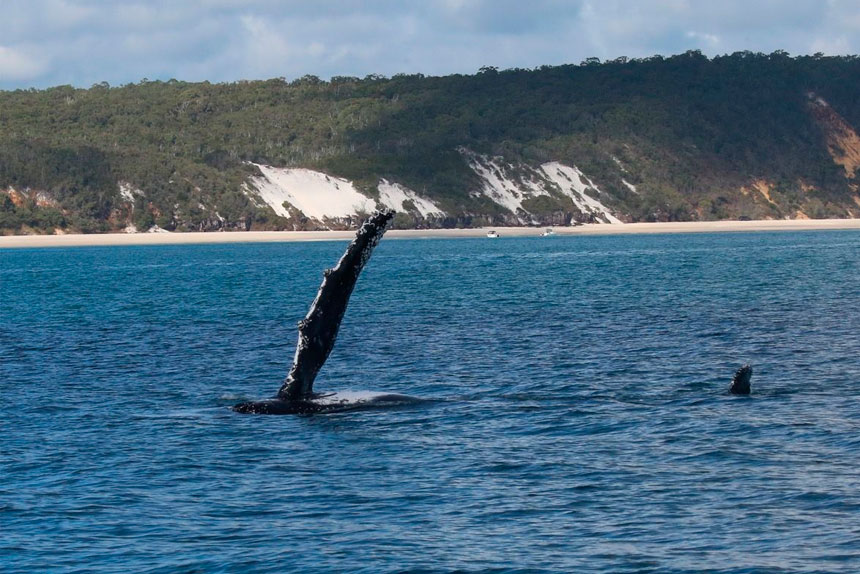
Spend some time at Point Lookout, North Stradbroke Island and there they are, spume blowing like a fountain, pecs slapping like an applause and the undersides of their tails displaying a personal fingerprint.
But to see them at play, it’s worth taking a three-hour drive to Hervey Bay, where the Great Sandy Straits offers a safe haven to take time out from their migration, display some rowdy courtship activity, find a mate and acclimatise their calves.
Hervey Bay Whale Watch skipper Sam Peaker said there were many reasons why whales came to the straits.
“They get protection like no other place. The waters are super shallow (20 metres) and protected by K’Gari (Fraser Island). There aren’t any predators and this becomes a place for the whales to recharge,” he said.
And since 1987, it has become a mecca for whale tourism.
“This is the holy grail and what makes Hervey Bay so famous,” he said.
Mr Peaker said he grew up working with charter boats and he remembers his father, John, as both a skipper and a commercial pilot, flying spotter planes and throwing from the plane rolls of toilet paper to mark the whale sites for the boats below.
“Dad was a pioneer in the industry at a time when there weren’t any mobile phones. Time has progressed a bit since then,” he said.
Nevertheless, the best way to spot a whale is by sight.
It doesn’t hurt that a lot of knowledge about whale behaviour helps with predicting where they will be and what they will get up to next.
The humpback is the fifth largest animal with a population of about 50,000. The migratory paths are different, but Mr Peaker said the larger females tended to be creatures of habit so, each year, the same whales were spotted.
“The whales are so familiar with the boats, they come to us, very close to the boat. They really turn it on because they know they are safe. Sometimes it’s just silly – chaos really, especially as some of these whales are about the length of the vessel and a lot heavier.”
He said the dense blubber served as an insulating coat in the Antarctic and food for its migration in areas where there was no krill, the whales’ food source.
One identity is Nala who has been stopping by with her calves since the early 1990’s. The rare all-white Migaloo is also a national whale icon, spotted at North Stradbroke Island.
Seasonal deck hand James Pappagallo, now working his third season, said he got his ‘start’ in the maritime industry on whale watch tours.
“Every day is different. Every day is flexible. I pretty much live full time out of my duffel bag, but seasonal work like this pays the bills and it’s fun,” Mr Pappagallo said.
The season at Hervey Bay was launched with a blessing of the fleet on July 10.
State Member for Hervey Bay David Lee said this was a chance for people to observe unique patterns of behaviour as the whales rested and played.
“It is also a time to celebrate marine life and a vibrant community,” he said.
The whale season runs until early October with best viewing in August and September.